Cape Town – Pollination biologist from Stellenbosch University Dr Corneile Minnaar is breaking new ground in a field of research that has been hampered by a lack of a universal method to track pollen for more than a century.
Despite more than 200 years of detailed research on pollination, Minnaar said researchers did not know for sure where most of the microscopically-tiny pollen grains land up once they leave flowers.
In an article published in the journal “Methods in Ecology and Evolution” this week, Minnaar described the method, which will enable pollination biologists to track the whole pollination process from the first visit by a pollinator to its endpoint – either successfully transferred to another flower’s stigma or lost along the way.
“Plants produce massive amounts of pollen, but it looks like more than 90% of it never reaches stigmas. For the tiny fraction of pollen grains that make their way to stigmas, the journey is often unclear – which pollinators transferred the grains and from where?”
Minnaar said quantum dots were semiconductor nanocrystals that were so small they behaved like artificial atoms. When exposed to UV light, they emitted extremely bright light in a range of possible colours.
In the case of pollen grains, Minnaar figured out that quantum dots with “fat-loving” ligands would theoretically stick to the fatty outer layer of pollen grains, called pollenkitt, and the glowing colours of the quantum dots could then be used to uniquely “label” pollen grains to see where they end up.
“I decided to design a fluorescence box that can fit under a dissection microscope. And, because I wanted people to use this method, I designed a box that can easily be 3D-printed for about R5 000, including the required electronic components,” Minnaar said.
So far the method and excitation box have proven itself as an easy and relatively inexpensive method to track individual pollen grains, Minnaar said.
“I’ve done studies where I caught the insects after they have visited the plant with quantum-dot labelled anthers, and you can see where the pollen is placed, and which insects actually carry more or less pollen.”
But the post-labelling part of the work still requires hours of painstaking counting and checking, Minnaar said.
“I think I’ve probably counted more than a hundred thousand pollen grains these last three years.”
A new study that allowed humans to spy on bumblebees inside their nests showed that pesticides can impair social behaviour, making it hard for bees to eat and rear their young, researchers said on Thursday.
Previous research has shown that the common class of pesticides known as neonicotinoids can harm bees’ ability to forage outside the nest.
The latest findings add to long-standing concerns about these important pollinators’ health.
Researchers tracked the changes in bees’ behaviour by placing cameras inside 12 specially made boxes that contained one chamber for a nest and another chamber for foraging.
Some bees were exposed to concentrations of the neonicotinoid imidacloprid similar to that expected in the environment. Others were not.
They found the pesticide-exposed bees were less social in a variety of ways than control bees placed in similar boxes but not fed nectar that contained neonicotinoids.
“Exposure to the neurotoxic pesticide resulted in measurable changes in worker bee behavior within the nest,” said the report in the journal Science.
“The workers were less active, less likely to feed and care for larvae, and more likely to be found towards the periphery of the nest.”
The effects were particularly noticeable at night.
“Bees actually have a very strong circadian rhythm,” said lead author James Crall, a postdoctoral fellow at Harvard University.
“So what we found was that, during the day, there was no statistically observable effect, but at night, we could see that they were crashing.”
Experiments also showed that pesticide exposure made it more difficult for bees to regulate their body temperature, and to build a protective wax cap over the colony.
“Almost all of our control colonies built that cap,” Crall said.
“And it seems to be totally wiped out in the pesticide-exposed colonies, so they lose this capacity to do this functional restructuring of the nest.”
Researchers said their findings add to mounting evidence of the harm posed by neonicotinoid pesticides.
The European Union has voted to outlaw the use of three neonicotinoids – clothianidin, imidacloprid and thiamethoxam – in crop fields.
France has gone even further and banned these three neonicotinoids plus thiacloprid and acetamiprid, both outdoors and in greenhouses.
In recent years, bees have been mysteriously dying off from “colony collapse disorder”, blamed partly on pesticides as well as mites, viruses, and fungi.
The United Nations has warned that 40% of the planet’s insect pollinators, particularly bees and butterflies, risk global extinction, which would have serious implications for food production and ecosystem health.
Cape Town – Although the Western Cape’s deciduous fruit industry is currently meeting the pollination requirements needed, the sector is expected to grow as demand for pollination services is set to double over the next decade.
To mitigate this, the Department of Agriculture is working with bee associations in the Western Cape, and has released a new strategy aimed at ensuring the sustainability of the province’s bee population.
According to the South African National Biodiversity Institute, more than 50 different crops in South Africa are reliant on insect pollination, and the honeybee is as important to agriculture as water, land and air.
In the Western Cape, 50% of commercial bee-keepers’ revenue currently comes from pollination services, with the remaining 50% coming from the production of honey and other bee-related products.
According to Hortgro, the representative body of the South African deciduous fruit industry, the current pollination needs required by bee-dependent deciduous fruit crops are 65 000 pollination units, a demand currently being met.
This is forecast to grow by at least another 30 000 units over the next decade, because of new cultivars and growth in agriculture, while the seed industry is also forecast to increase demand for pollination units by 30 000 over the next decade and the berry growers by another 20 000 units, thereby resulting in the demand for pollination services being expected to double in the next decade.
However, the bee industry has identified several problems affecting bees, including insufficient forage, theft and vandalism, disease, and environmental hazards, such as pollution, and exposure to external factors such as fires and drought.
The new strategy aims to ensure the continued sustainability of the bee population by focusing on five key areas, including: ensuring sustainable bee forage; research and innovation; developing a regulatory framework; transformation in the industry, and governance and stakeholders.
According to the bee industry, the single largest concern was that there would not be enough forage for bees in the Western Cape, as South Africa’s honeybee species rely on both indigenous and exotic species, like eucalyptus, flowering crops and suburban plants to provide forage sources year round.
Economic Opportunities MEC Alan Winde welcomed the strategy.
He said a properly regulated and managed industry had the potential to create jobs and expand the economy.
“The report shows that in South Africa, we import a lot of honey. South Africa has imported 2 000 tonnes of honey annually since 2010, and honey production has dropped to 40% of what it was in the 1980s. This is an agri-processing opportunity: to produce local honey, and honey-related products, right here in the Western Cape,” he said.
Tlou Masehela, the chairperson of the Western Cape Bee Industry Association, said: “This is a detailed plan, and we now have a line of communication with the various government departments. This will require resources – and we must explore ways of getting those. The industry at large should really pull together and make this work.”
Numerous threats to the environment, including climate change, disease and habitat destruction, have placed the global bee species under threat, making them especially vulnerable to extinction.
That was the warning sounded in a research paper by Dr Annalie Melin, postdoctoral research fellow in the interdepartmental Centre for Statistics in Ecology, Environment and Conservation (SEEC) in the University of Cape Town’s (UCT) Faculty of Science.
Melin, together with co-author Dr Jonathan Colville, an honorary research associate at the SEEC, dedicated their research paper to assessing the rich taxonomic and natural history exploration of South African bees.
The paper, titled A review of 250 years of South African bee taxonomy and exploration (Hymenoptera: Apoidea: Anthophilia)*, describes bees as a “taxonomically diverse group of insects” with an estimated 20 000 species worldwide. They are also ecologically diverse, with a wide range of lifestyles, nesting behaviours and social complexities.
The paper shines the spotlight on South African bees and assesses the status of the taxonomic activity and exploration of the South African bee fauna, tracking its progress over the past two-and-a-half centuries.
Key research findings
Melin and Colville’s research indicates that a large part of South Africa’s bee fauna remains undiscovered, and that nearly a third of the country’s 80 genera require taxonomic revision. They say almost 70% of South Africa has been poorly surveyed for bees, with no records at all for a large part of the country.
“Another major concern is the diminishing capacity and expertise in South Africa to undertake bee surveys and species descriptions.
“Another major concern is the diminishing capacity and expertise in South Africa to undertake bee surveys and species descriptions.”
“This is especially concerning [given that] South Africaʼs pre-eminent bee taxonomist, responsible for the bulk of the taxonomic work undertaken in the last 40 years, is retiring next month,” Melin said.
SA’s bee species
Over the 250-year period, there have been three distinct peaks in the number of new bee species described in South Africa. Melin said of the 947 described species that the highest peak is seen between 1930 and 1935, with 108 species described, followed by an additional peak between 1900 and 1905, with 97 species. A third peak between 2000 and 2005 saw 79 species described.
According to Melin, during the first half of the study period, which focused on 1765 to 1895, a low rate of species of bees were described, followed by a sharp increase from the 1900s, and dropping gradually from the 1950s.
“The number of publishing taxonomists per five-year interval fluctuated over the study period, ranging from a low of between none and two taxonomists during 1765 to 1865 and again over 1940 to 1960, to a high of 11 taxonomists in the 2000s.
“The positive trend points towards an increase in the number of bee taxonomists over time. However, looking more closely at who has been doing the bulk of recent species descriptions, one realises that only one of these active taxonomists (Connal Eardley) is based in South Africa,” the paper indicates.
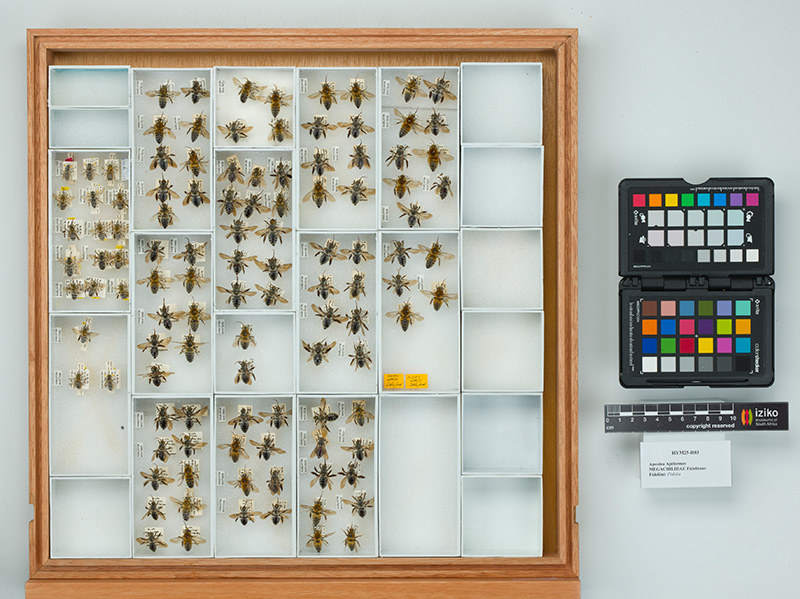
An Insect cabinet drawer of bee specimens housed at Iziko Museums of South Africa. Information from such specimens was used in the study by Melin and Colville. Photo Iziko Museums of South Africa.
Bee diversity hotspot
South Africa has been recognised globally as a bee diversity hotspot, with close to 1 000 bee species, many of which are endemic to the Fynbos and Succulent Karoo biomes. However, Melin said, more work needs to be done to achieve comprehensive bee inventories for South Africa.
“[There’s] an urgency to obtain these in light of reports of global bee declines and the unprecedented loss of species. Current global headlines proclaim ‘insect Armageddon’ due to drastic declines in insect numbers worldwide.”
According to Melin, bees are a “seemingly well-studied” insect group in South Africa, so highlighting the concerning situation for other less studied insect groups in the country. Unfortunately, she said, South Africa lags behind in its ability to document these declines.
“We only have the most basic of knowledge for many of our insects and this poses the very real possibility that we will lose insect species before we have discovered them.”
“We only have the most basic knowledge of many of our insects and this poses the very real possibility that we will lose insect species before we have discovered them.”
Researchers’ recommendations
An enormous amount of work has been achieved during the past few decades, Melin said. But despite this, a significant effort is still needed. Additional research and resources are required to adequately document and fully characterise South Africa’s regional bee fauna.
To accomplish this, an urgent increase in local taxonomic capacity is required in order to increase the rate of insect species discovery and descriptions.
“Considering the significant ecological and economic importance of bees in South Africa, we hope that the need to increase bee taxonomic capacity will penetrate the portals of universities, as well as government and local funding bodies. This will require ring-fenced funding and, crucially, the creation of permanent jobs at universities, museums and government research institutes.
“If we consider bees as a surrogate group for other South African insects, the far-reaching implications of our results suggest that, overall, the South African entomofauna has been poorly surveyed,” Melin said.
Deep in the jungles of Indonesia, the world’s largest bee nl. ‘Flying Bulldog’ was rediscovered.
The bee (full name Megachile pluto) is a giant insect about the size of a human thumb and lives in the Indonesia island region of the North Moluccas. It makes its nest in termite mounds, using its large fang-like mandibles to collect sticky resin to protect its home from the termites.
The IUCN Red List of Threatened Species lists the bee as “vulnerable”, meaning that while its numbers are relatively solid, the remoteness of its population makes it hard to study.
Several previous expeditions to the region where the bee lives failed to spot it.
Indonesia is home to an abundant variety of flora and fauna but there are fears for some animal and insect communities as forests being cut down for agriculture threaten many species’ natural habitat.
Despite its conspicuous size, no one had observed Wallace’s giant bee — discovered in the 19th century by British naturalist Alfred Russel Wallace and nicknamed the “flying bulldog” — in the wild since 1981, the Global Wildlife Conservation said.
‘Flying Bulldog’ monster bee (full name Megachile pluto) shown here next to a normal honey bee.