
Adorable image of sleeping bees as captured by Joe Neely of JMNeelyphotography.com


Adorable image of sleeping bees as captured by Joe Neely of JMNeelyphotography.com
Wait…? What?
Do bees sleep, do they sleep at night, and if so, where and how do we know they are sleeping?
As one of the most studied creatures on the planet, it’s no surprise that scientists have asked many questions, including “do bees sleep?”
First, some simple questions and answers, but further down the page, we get into the science, in case you want to read it!
Please note, that all of the research contained in this article relates to honey bees. I make some remarks about bumble bees later.
Do bees sleep?
The short answer to the first question is: according to scientists, YES, bees do sleep!
How do we know bees sleep and how do they sleep?
Scientists have looked at how humans and other mammals sleep, and they have found bees do similar things. For example, just as humans (and other mammals) take on a very relaxed posture, and go through different phases of sleep (relaxed, light sleep, deep sleep), so do bees!
So how do they sleep and what do they look like when they are sleeping?
It turns out that when a bee is in deep sleep, their antennae droop downwards, the upper body (thorax) drops as does the tip of the abdomen (or tail), and the wings rest on the body.
Look closely, and you can see this in the images below.
Note how in the first image (A), the bee is alert: it has wings up and extended, the whole body is off the ‘floor’, and antennae are facing forward.
Note the changes in the body posture as the bee falls into a deep sleep – in picture D!
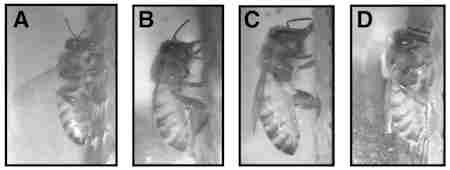
This image is from the scientific paper; ref: Eban-Rothschild, A. D. and Bloch, G. (2008). Differences in the sleep architecture of forager and young honeybees (Apis mellifera). J. Exp. Biol. 211,2408 -241
Scientist also found that body temperature of bees drops when they sleep (it does in humans too!) and that the deeper a bee is sleeping, the brighter the light needed to wake the bee – again, a little like humans. Finally, certain distinct patterns happen in the brain when bees are sleeping.
When do bees sleep? Do bees sleep at night, or do they sleep during the day? At what time do bees sleep?
In honey bees, there is some variance depending on the role within a colony. Forager bees – the older bees within the colony, are active during the day, but sleep at night back in the nest or bee hive.
However, foragers go through different sleep stages of light sleep and deeper sleep, and when awake they may be immobile (not moving) or may groom.
Very young worker bees (whose duties include cleaning the cells), also sleep in the hive or nest, but they have no fixed pattern of sleep as the foragers do. Instead, they may be active during day or night, with periods of sleep in between, spread out over a 24 hour period. Scientists say they found no consistent differences in the percentage of time that foragers and young workers spent sleeping.
However, scientists suggest that all the interaction with other bees at the hive, is possibly what makes young bees sleepy and in need of regular naps, in particular, because of all the information they are receiving from and giving to other bees!
What about bumble bees?
I have not found a specific piece of research investigating this, but I certainly believe bumble bees sleep, and in particular, I have come across bumble bee males in the morning, apparently sleeping on flowers. They are immobile, with drooped antennae, and it may take a little while for them to wake up!
What do bees do when they wake up?
Researchers found that the first thing honey bees do, is groom when they wake. They may then either go back to sleep, or get on with their usual roles within the colony (see above).
Where do bees sleep?
In honey bees, it all depends on the role within a colony. Research found that foragers (the older bees) sleep toward the perimeter (edge) of a nest or hive, whereas younger worker bees sleep inside cells and also, closer to the centre of the nest.
As stated above, I believe bumblebee males may sleep outside of the nest (at least sometimes) on flowers. I have seen them on cosmos, lamb’s ear, buddleia and lavender among others.
Why do bees need sleep?
It seems bees need their sleep, because otherwise (just like humans), their performance is hampered. Scientists found that bees deprived of sleep would have difficulty learning a new route home, and were not able to waggle dance properly, and they may also show signs of sleepiness during the day.
How can we know whether bees are sleeping?
Is it really possible to prove whether or not bees are sleeping, or is it merely guesswork on the part of scientists? Scientists may have cracked the code behind the honey bee waggle dance, but how can scientists really know whether a bee is asleep or not? To answer this question, scientists say that it all depends on how we define ‘sleep’, and it seems that the state we refer to as ‘sleep’ in humans and mammals is also witnessed in bees!
Put another way, when we identify and define the criteria for what we call sleep in mammals, it seems similar states are exhibited by honey bees when they are at rest, such that it can be said that they are indeed sleeping.
Sleep in honey bees is similar to mammals in the following ways, including:
So here is the proof, according to scientists, that honey bees exhibit ‘sleep’ behaviours:
Sleeping Posture
Honey bees sleep with their thorax (upper body), head and antennae relaxed, and the sleepier and more deeply asleep, the more relaxed the bees’ body becomes, as is the case for humans.
 Again, you can see this happening in the images below. In the first image (A), the honey bee is awake, but immobile. Her wings are up, as are the antennae, and her body is off the floor. As the bee passes through different stages of sleep, the wings relax, the antennae point downwards, until eventually (as can be seen in photograph D) the tip of her abdomen is on the floor, and her thorax (upper body) is lowered.
Again, this amazing set of photographs above of a honey bee sleeping, is from the research paper by Eban-Rothschild and Bloch as detailed earlier.
This characteristic posture as shown in D is associated with a decrease in muscle tonus and body temperature, and an increase in response threshold, measured both neurophysiologically and behaviourally (Kaiser and Steiner-Kaiser, 1983; Kaiser, 1988).
Characteristic brain electrical activity and a characteristic brain gene expression signature
What happens in bee brains when they are sleeping?
When forager honey bees were in deep sleep (determined as periods lacking antennal movements), then this correlated with rhythmic electrophysiological activity in the brain, including the mushroom bodies (Schuppe, 1995). There are three specific classes of neurons that make up the mushroom body lobes: α/β, α’/β’, and γ-neurons, which all have distinct gene expression.
An elevated response threshold
Further research found that the deeper the sleep, the greater the stimulus needed to induce a bee to respond. This was tested using light. Honey bees that were more awake responded to a lower intensity light source with movement, than bees in a deeper sleep state. A higher intensity light source was required to facilitate a response from bees in a deeper sleep state (Eban-Rothschild, A. D. and Bloch, G. (2008).
Do bees need sleep? Do some bees sleep more than others?
Yes, as stated previously, it seems bees need their sleep, or, just like humans, their performance is hampered:
“We found no consistent differences in the percentage of time that foragers and callows [the young workers] spent sleeping ….. In the experiment with bees from colony H3, callows slept more than foragers (t-test, P<0.05), whereas in colony S25 callows slept less (P<0.05). It is not clear whether this variation across trials reflects genetic differences between colonies, or stems from variability in experimental procedures (lab vs hive environment before monitoring sleep.”
Sleeping patterns
Again, in research in honey bees, it really depends on the role the bee has within the colony.
The foragers are the older adult bees. They spend the day foraging and sleep at night, and have a well defined sleep pattern, although their sleep patterns are characterised by phases. But what about the younger worker bees? When do worker bees sleep? Eban-Rothschild and Bloch found they remain active until sunset, with periods of sleep in between.
Where bees sleep – by role in colony?
Honey bee workers typically progress through a chronological sequence of task-based castes (or rank), beginning adulthood as cell cleaners, later tending brood and queen as nurse bees, then receiving and storing nectar as food storers, and ultimately serving as the colony’s foragers, thus foragers being the older worker bees in the colony.
Scientists investigated whether role within the colony influenced where the bee sleeps. Older worker bees generally slept outside cells, closer to the edge of the nest, in cooler areas, and away from uncapped brood. Younger worker bees generally slept inside cells and closer to the centre of the nest, and spent more time asleep than awake when surrounded by uncapped brood. The average surface temperature of sleeping foragers was lower than the surface temperature of their surroundings, offering a possible indicator of sleep for this caste. (Klein, Stiegler, Klein and Tautz,2014).
Article source: Do bees sleep?
Image credit: Joe Neely Photography

Take a look at this fascinating time-lapse of a honey bee hatching.
Unlike a bumble bee colony or a paper wasp colony, the life of a honey bee colony is perennial. The three types of honey bees in a hive are: queens (egg-producers), workers (non-reproducing females), and drones (males whose main duty is to find and mate with a queen). Honey bee larvae hatch from eggs in three to four days. They are then fed by worker bees and develop through several stages in the cells. Cells are capped by worker bees when the larva pupates. Queens and drones are larger than workers, so require larger cells to develop. A colony may typically consist of tens of thousands of individuals.
While some colonies live in hives provided by humans, so-called “wild” colonies (although all honey bees remain wild, even when cultivated and managed by humans) typically prefer a nest site that is clean, dry, protected from the weather, about 20 liters in volume with a 4- to 6-cm2 entrance about 3 m above the ground, and preferably facing south or south-east (in the Northern Hemisphere) or north or north-east (in the Southern Hemisphere).
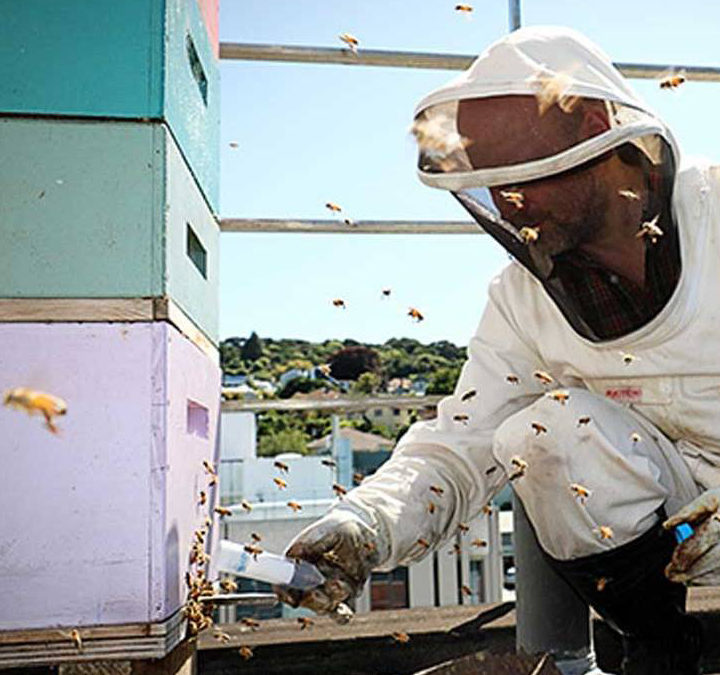
A new study from the University of Otago and the university of Heidelberg has found a link between activity in the brain of bees and humans. The team found that the alpha oscillations in bees have similar properties to the human brain. Alpha oscillations are associated with brain functions like attention, memory, and consciousness.

The sample of human EEG with prominent alpha-rhythm in occipital sites
Researchers believe that bee brains could provide new avenues to understand how the human brain works. Human experimentation is expensive, logistically difficult, and time-consuming, says Paul Szyszka. He also notes that recordings from individual identified neurons aren’t possible in human brains.
Szyszka collaborated with Dr. Tzvetan Popov of the University of Heidelberg in Germany, the study’s lead author, to study the brains of regular honey bees living in outdoor hives.
Studying the brains of bees allows scientists to overcome the limitations and apply that knowledge to research and potentially treat human brains. In their research, the team used regular honeybees from outdoor hives. The bees were stimulated with odours in the lab with microscopic electrodes.
Scientists say that it is “fascinating” to see how the alpha oscillations in the bee brain change during natural behaviours. Researchers say that bees can learn to associate odours with food in a similar way as humans can. The team now wants to determine how the alpha oscillations change in different situations. Specifically, they want to know how they change when a bee forages or sleeps.
Szyszka is now looking for students looking to master in Zoology or Neuroscience to continue the project. The goal is to further examine the relationship between brain waves and learning memory. The team doesn’t say how the microscopic probes are inserted in the bee brains. The research is a collaboration between multiple universities, including the University of Heidelberg in Germany.
Source article 1: Honeybee brains could be a good model to study the human brain
Source article 2: Study finds similarities in bee brains and human brain activity

The humble honeybee can use symbols to perform basic maths including addition and subtraction, shows new research published today in the journal Science Advances.
Despite having a brain containing less than one million neurons, the honeybee has recently shown it can manage complex problems – like understanding the concept of zero.
Honeybees are a high value model for exploring questions about neuroscience. In our latest study we decided to test if they could learn to perform simple arithmetical operations such as addition and subtraction.
As children, we learn that a plus symbol (+) means we have to add two or more quantities, while a minus symbol (-) means we have to subtract quantities from each other.
To solve these problems, we need both long-term and short-term memory. We use working (short-term) memory to manage the numerical values while performing the operation, and we store the rules for adding or subtracting in long-term memory.
Although the ability to perform arithmetic like adding and subtracting is not simple, it is vital in human societies. The Egyptians and Babylonians show evidence of using arithmetic around 2000BCE, which would have been useful – for example – to count live stock and calculate new numbers when cattle were sold off.
But does the development of arithmetical thinking require a large primate brain, or do other animals face similar problems that enable them to process arithmetic operations? We explored this using the honeybee.
Honeybees are central place foragers – which means that a forager bee will return to a place if the location provides a good source of food.
We provide bees with a high concentration of sugar water during experiments, so individual bees (all female) continue to return to the experiment to collect nutrition for the hive.
In our setup, when a bee chooses a correct number (see below) she receives a reward of sugar water. If she makes an incorrect choice, she will receive a bitter tasting quinine solution.
We use this method to teach individual bees to learn the task of addition or subtraction over four to seven hours. Each time the bee became full she returned to the hive, then came back to the experiment to continue learning.
Honeybees were individually trained to visit a Y-maze shaped apparatus.
The bee would fly into the entrance of the Y-maze and view an array of elements consisting of between one to five shapes. The shapes (for example: square shapes, but many shape options were employed in actual experiments) would be one of two colours. Blue meant the bee had to perform an addition operation (+ 1). If the shapes were yellow, the bee would have to perform a subtraction operation (- 1).
For the task of either plus or minus one, one side would contain an incorrect answer and the other side would contain the correct answer. The side of stimuli was changed randomly throughout the experiment, so that the bee would not learn to only visit one side of the Y-maze.
After viewing the initial number, each bee would fly through a hole into a decision chamber where it could either choose to fly to the left or right side of the Y-maze depending on operation to which she had been trained for.


“Unless we change our way of producing food, insects as a whole will go down the path of extinction in a few decades,” concluded the peer-reviewed study, which is set for publication in April.
The recent decline in bugs that fly, crawl, burrow and skitter across still water is part of a gathering “mass extinction,” only the sixth in the last half-billion years.
“We are witnessing the largest extinction event on Earth since the late Permian and Cretaceous periods,” the authors noted.
The Permian end-game 252 million years ago snuffed out more than 90 percent of the planet’s life forms, while the abrupt finale of the Cretaceous 66 million years ago saw the demise of land dinosaurs.
“We estimate the current proportion of insect species in decline – 41 percent – to be twice as high as that of vertebrates,” or animals with a backbone, Francisco Sanchez-Bayo of the University of Sydney and Kris Wyckhuys of the University of Queensland in Australia reported.
“At present, a third of all insect species are threatened with extinction.”
An additional one percent join their ranks every year, they estimated. Insect biomass – sheer collective weight – is declining annually by about 2.5 percent worldwide.
“Only decisive action can avert a catastrophic collapse of nature’s ecosystems,” the authors cautioned.
Restoring wilderness areas and a drastic reduction in the use of pesticides and chemical fertiliser are likely the best way to slow the insect loss, they said.
‘Hardly any insects left’
The study, to be published in the journal Biological Conservation, pulled together data from more than 70 datasets from across the globe, some dating back more than a century.
By a large margin, habitat change – deforestation, urbanisation, conversion to farmland – emerged as the biggest cause of insect decline and extinction threat.
Next was pollution and the widespread use of pesticides in commercial agriculture.
The recent collapse, for example, of many bird species in France was traced to the use insecticides on industrial crops such as wheat, barley, corn and wine grapes.
“There are hardly any insects left – that’s the number one problem,” said Vincent Bretagnolle, an ecologist at Centre for Biological Studies.
Experts estimate that flying insects across Europe have declined 80 percent on average, causing bird populations to drop by more than 400 million in three decades.
Only a few species of insects – mainly in the tropics – are thought to have suffered due to climate change, while some in northern climes have expanded their range as temperatures warm.
In the long run, however, scientists fear that global warming could become another major driver of insect demise.
Up to now, rising concern about biodiversity loss has mostly focused on big mammals, birds and amphibians.
Dung beetles in deep
But insects comprise about two-thirds of all terrestrial species, and have been the foundation of key ecosystems since emerging almost 400 million years ago.
“The essential role that insects play as food items of many vertebrates is often forgotten,” the researchers said.
Moles, hedgehogs, anteaters, lizards, amphibians, most bats, many birds and fish all feed on insects or depend on them for rearing their offspring.
Other insects filling the void left by declining species probably cannot compensate for the sharp drop in biomass, the study said.
Insects are also the world’s top pollinators – 75 percent of 115 top global food crops depend on animal pollination, including cocoa, coffee, almonds and cherries.
One-in-six species of bees have gone regionally extinct somewhere in the world.
Dung beetles in the Mediterranean basin have also been hit particularly hard, with more than 60 percent of species fading in numbers.
The pace of insect decline appears to be the same in tropical and temperate climates, though there is far more data from North America and Europe than the rest of the world.
Britain has seen a measurable decline across 60 percent of its large insect groups, or taxa, followed by North America (51 percent) and Europe as a whole (44 percent).